


What is the purpose of a trust in BC?
The purpose of a trust in BC is to hold and manage assets for specified beneficiaries.
The benefit of a trust is that it provides greater flexibility, control, and protection for transferring wealth. When you create a trust, you define the rules for managing the assets and the conditions under which beneficiaries are entitled to the property.
A trust can offer tax advantages, creditor protection, business succession opportunities, beneficiary protection, asset protection, and help to avoid probate.
Note: This information is general in nature; you should speak to a lawyer or tax professional about your situation.
Written By Tiffany Woodfield, Financial Advisor, TEP®, CRPC®, CIM®

Table of Contents
- What are the key roles in a trust?
- How to set up a trust in BC
- What are the most common types of trusts in BC?
- What is the main purpose of using a trust in BC?
- What are the major pitfalls to watch out for when creating a trust in BC?
- What matters most to you?
- FAQ
What are the key roles in a trust?
Settlor:
A settlor is the individual who creates the trust and transfers their property to a trust. When transferring assets to a trust, a settlor is also transferring legal ownership of the property to the trust. The settlor can also be a trustee, but it is generally not recommended, as it can have adverse tax consequences.
Trustee:
A trustee is the individual(s) or corporation that manages the trust in accordance with the trust document. The trustee holds the legal title to the property and has a fiduciary responsibility to act in the best interest of the beneficiary(s). There can be more than one trustee, and they must comply with the Trustee Act in their jurisdiction.
Beneficiary:
A beneficiary is the individual(s) who receives the income or assets from the trust. You can have various beneficiaries with different conditions on when and how much they receive.
How to Set Up a Trust in BC
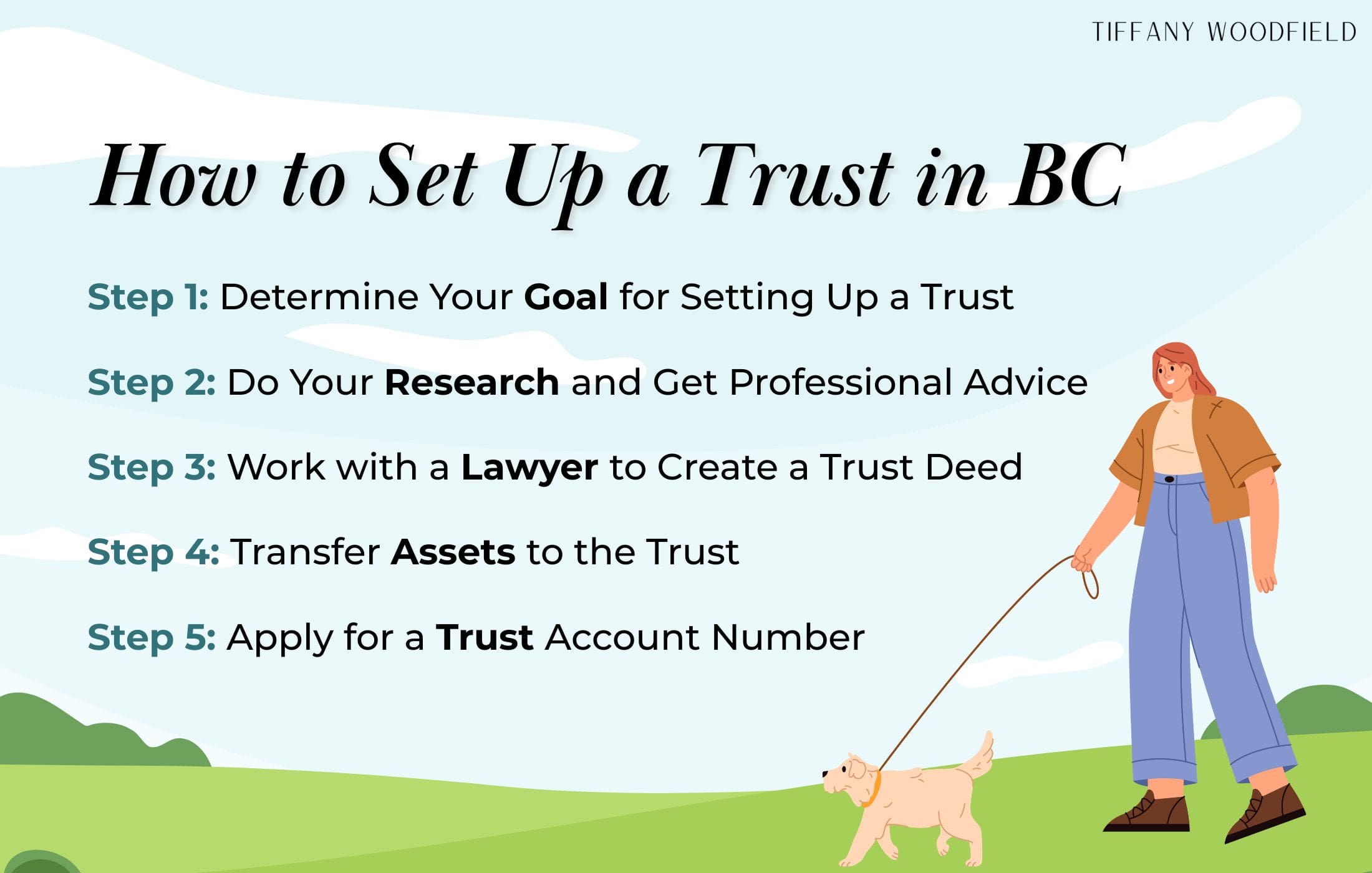
Step 1: Determine Your Goal for Setting Up a Trust
Setting up a trust incurs costs, so it is essential to ask yourself what you want to achieve with the trust.
- Do you need a living trust or a testamentary trust?
- Do you have minor children?
- Do you run a business that has active and non-active family members?
- Do you have a spendthrift child?
- Do you have a child with a disability?
- Are you in a blended family?
Step 2: Do Your Research & Get Professional Advice
Once you have brainstormed why you want to set up a trust and identified who you want as your trustee and beneficiary, it can be helpful to conduct your own research to gain a basic understanding of how trusts work.
But remember this doesn’t replace the need to get professional advice. It is great to ask friends and other professionals whom they would recommend as an estate planning lawyer.
Step 3: Work with a Lawyer to Create a Trust Deed
I recommend working with a professional to create your trust deed. You will want to outline the trustee powers, the conditions that need to be met, the beneficiaries’ rights, and the rules for asset distribution.
Step 4: Transfer Assets to the Trust
Once you have the legal document, you will need to transfer the property to the trust. This can be real estate, shares, investments, or other property.
Step 5: Apply for a Trust Account Number
Once the trust is set up and funded, you will need to register the trust with the Canada Revenue Agency. In addition, the trust is usually required to file a tax return and beneficial ownership information each year.
What are the most common types of trusts in BC?
The most common types of trusts in BC are inter vivos trusts (living trusts), discretionary trusts, testamentary trusts, family trusts, and alter ego trusts.
Inter Vivos or Living Trust:
How It Works in BC
An Inter Vivos Trust is created while you are alive. You are the settlor and transfer assets (such as investments, real estate, or private company shares) into the trust.
- The trustee becomes the legal owner of the assets.
- While you can be the settlor, trustee, and beneficiary, it isn’t generally recommended because of negative tax consequences.
- Assets inside the trust do not go through probate when you die.
- In BC, transferring assets into the trust may trigger capital gains tax at the time of transfer (unless an exemption applies, such as with an Alter Ego Trust).
Who It’s For
An inter vivos trust is for:
- People who want to avoid probate on specific assets.
- Individuals with privacy concerns (trusts are not public like wills).
- Families with complex planning needs and blended families.
- Families for business succession planning.
- People who understand that tax planning must be done carefully before funding the trust.
In BC, probate fees are approximately 1.4%* on assets over $50,000, so this can be a motivating factor. If the estate were valued at $10M, it could lose just under $140,000 simply from going through probate. However, tax consequences must be weighed carefully.
Testamentary Trust:
How It Works in BC
A Testamentary Trust is created by your will and only comes into effect after you die.
- Assets flow through your estate first
- Probate does apply
- Once established, the trust holds and manages assets for beneficiaries
- Since 2016, testamentary trusts no longer get special tax rates (they are taxed at top marginal rates with limited exceptions)
Who It’s For
- Parents leaving money to minor children
- Families wanting structured distributions over time
- Situations where beneficiaries need protection from poor financial decisions
- Estates where probate is acceptable or unavoidable
This is still very common in BC estate planning, especially for families.
Discretionary Trust:
How It Works in BC
A Discretionary Trust gives trustees full discretion over:
- When beneficiaries receive money
- How much they receive
- Whether they receive anything at all in a given year
Beneficiaries do not have an automatic right to the assets.
Who It’s For
- Families wanting maximum flexibility
- Protecting assets from:
- Divorce claims
- Creditors
- Spendthrift beneficiaries
- Beneficiaries with disabilities or unstable income
Discretionary trusts are often used within family trusts or testamentary trusts rather than as standalone trusts.
Family Trusts:
How It Works in BC
A Family Trust is a type of Inter Vivos Trust commonly used for:
- Holding private company shares
- Income splitting (within strict CRA rules)
- Estate freezes
Key BC considerations:
- Often paired with a holding company
- Subject to federal tax rules (e.g., TOSI)
- Assets inside the trust bypass probate if properly structured
- The trust has a 21-year deemed disposition rule, which can trigger capital gains tax
Who It’s For
- Business owners
- Professionals with incorporated practices
- Families building multi-generational wealth
- People who need advanced tax and succession planning
This is not a trust that you should use for DIY planning, as it requires coordinated legal and tax advice.
Alger Ego Trusts:
How It Works in BC
An Alter Ego Trust is available only to individuals age 65+.
- You transfer assets into the trust
- You keep control of the assets as trustee and beneficiary
- You are the only person who can benefit from the income or capital while alive
- No capital gains tax is triggered on transfer
- Assets bypass probate on death
- On death, the trust is taxed as if the assets were sold (capital gains apply then)
This trust essentially allows you to be in control as the settlor/trustee and beneficiary until death. It is explicitly recognized in BC and other provinces for estate planning and is widely used.
Who It’s For
- BC residents 65 or older
- People with substantial investment portfolios
- People with multiple properties
- Anyone with privacy concerns
- Families who want to avoid probate without giving up control
- Individuals who want a clean, predictable estate transfer
What is the main purpose of using a trust in BC?
The primary purpose of establishing a trust in British Columbia is to transfer wealth to the next generation while ensuring your wishes are honored.
Trusts provide greater control over how your assets are distributed and can help preserve family wealth in a structured manner. Although the tax advantages have diminished over recent years, trusts still offer significant benefits and flexibility in estate planning.
What are the major pitfalls to watch out for when creating a trust in BC?
Creating a trust in British Columbia comes with some significant mistakes you need to avoid.
First, if you don’t properly fund or structure the trust, it won’t work as intended.
In addition, if you don’t get professional help with trust law, you may end up dealing with significant tax and legal issues. Choosing the wrong trustee can create substantial problems. For example, if you choose someone who doesn’t understand money, is disorganized, or is unfair as your trustee, your family may deal with a lot of drama in the future.
Moreover, if you set up an irrevocable trust, you won’t be able to change your mind later, since you usually lose control of it.
Overall, you should seek expert advice to ensure your trust is set up correctly and meets your objectives. It is also important to clearly explain your wishes to your family and why you’re setting up a trust, because it can help facilitate the process.

What matters most to you?
Trusts are powerful tools, but the best structure depends on what you’re trying to protect and why. Before you choose a trust, it helps to get clear on what matters most because the ‘best’ trust strategy isn’t the same for everyone.
Often, when I speak to my clients, they haven’t had the opportunity or encouragement to determine what matters most to them.
We are so bombarded with podcasts, endless scrolling, and news that it can be challenging to listen to ourselves and connect with what we need and want. Often, I hear clients repeating what they have heard rather than speaking from their own core desires.
They want to make smart financial decisions, but don’t understand that the “right” decision isn’t the same for everyone. When it comes to estate planning, there isn’t one perfect solution that works for everyone.
Example: The Woman Who Had Everything
Recently, I met with a woman in her 80s who had more than enough money to live the life she wanted.
In fact, she couldn’t possibly spend everything in her lifetime. She came to me because she was considering moving to a location she loved. She would be around family and a community that shared her values.
The problem was that if she moved, she would incur a significant capital gains tax bill.
If she spread this out over three years, she would pay less tax.
Now, of course, we all want to pay less tax. But we also need to ask ourselves what the cost of any decision might be. In this case, the cost of paying less tax would be losing time. This woman wanted to move but was afraid of taking action because she was worried about capital gains that she could easily afford.
When it comes to estate planning, you want to make sure you’re not falling into this same trap. You could call this the “avoidance trap.”
You’re focused so much on avoiding a problem that you don’t optimize for what matters most i.e. creating a legacy that is meaningful to you and your loved ones.
Why Emotions Influence Estate Planning Decisions
I’ve worked for years in the finance industry, and what initially motivated me was the knowledge that money isn’t just about strategic and logical decisions.
Money always has an emotional component, which can lead to limiting beliefs that can hold us back. Things like judgments about how we spend money and fears around there never being enough can hold people back from enjoying their lives.
I have extensive education in the financial field, and I love helping clients use tools to save money and live the life they want. But what I find in more than 90% of cases is that no matter how many zeros they have behind their names, people do not have money freedom.
Many people with great wealth are as fearful and emotional about money as those with very little.
But what does this have to do with your estate planning?
It’s important to make sure that you know what matters most to you when doing any kind of financial planning, especially estate planning. You must know what matters most so that you can be sure you’re making decisions that align with your goals and values rather than being driven by fear.
People often avoid estate planning out of fear.
Others create excessively complex estate planning structures as they seek to control every aspect of the estate. While doing this, they may overlook more simple, elegant, or effective solutions.
Instead, try to focus on what matters most to you and use that as your guide when you decide how you want to distribute your assets and whether or not a trust or any other tool makes sense for your family.
True Financial Freedom
True freedom is when your goal is what you value in life.
True freedom is allowing money to be a tool and not the goal to chase or to run away from. Because in either case, whether you are running from money or toward it, you are off track and not in alignment with what matters most to you.
What I wish for is that through education and internal reflection, people can live a life where money doesn’t hold as much power over them.
Money is just the tool you can use to support you in doing what you love.
When you approach your estate planning, try to bring an open heart and mind to the process and connect to what matters most to you. Make sure your decisions are driven by more than just money.

FAQ
How much does it cost to set up a trust in BC?
In BC, setting up a trust typically costs $3,000–$10,000+, depending on complexity, legal drafting, and tax planning involved.
What is the trust tax rate in BC?
Most trusts in Canada are taxed at the top marginal rate (about 53% in BC) unless income is distributed to beneficiaries.
What should you not put in a trust?
You generally should not put registered accounts (RRSPs, TFSAs), personal-use assets, or assets that trigger unnecessary tax into a trust.
Registered accounts already pass outside the estate through beneficiary designations, and placing them in a trust can cause immediate tax consequences.
Personal-use assets can also create administrative complexity without providing meaningful probate, tax, or control benefits.
What are the disadvantages of putting your assets in a trust?
Trusts can create higher tax rates, setup costs, ongoing administration, and loss of personal ownership, making them unsuitable for simple estates.
Is it better to have a will or a trust in Canada?
A will is essential for everyone in Canada because it governs how your estate is distributed and who has legal authority to act. A trust is only better in specific situations, such as probate avoidance, privacy, incapacity planning, or complex family or business structures. A trust should be used in addition to a will, not in lieu of a will.
What happens to a trust after death?
After death, a living trust becomes irrevocable, and the named successor trustee takes over management and distribution of assets in accordance with the trust deed, thereby avoiding probate. A testamentary trust takes effect upon death. After the probate process, the assets are transferred into the trust and managed according to the will’s terms by the trustee. For more on who controls a trust after death, read this article.
Why are some banks stopping trust accounts?
First, well-structured trusts used for estate planning, succession, or probate avoidance are not being targeted, and banks in Canada continue to open and service these accounts every day.
Instead, what is changing is how strict banks are about documentation and transparency.
So what’s actually happening?
Some banks in Canada are restricting or closing certain trust accounts due to increased compliance, reporting, and risk-management requirements, not because trusts are invalid.
Banks are under pressure from federal rules designed to cut down on money laundering and the funding of terrorists. They are required to detect and report risks, and may cut relationships based on their risk models. The practice of “debanking” or “de-risking” isn’t specifically about the legal validity of trusts themselves. And it happens with various types of accounts, not just trust accounts, when banks perceive that the risk or compliance burden is too high.
The banks often cannot explain the reason because anti-tipping-off laws prohibit them from disclosing details of suspicious activity reports.
What is the 21-year rule for trusts in Canada?
Every 21 years, most trusts are deemed to have disposed of their assets at fair market value, potentially triggering significant capital gains tax. It is like the trust sold all the assets at the fair market value, and any capital gains will be taxed. Strategic planning can be used to distribute all or some assets before the 21-year mark.
Read More:
💎 What Is a Living Trust in BC?
💎 Who Controls a Trust After Death?
About the Author

TIFFANY WOODFIELD is a senior financial advisor, estate-planning expert, and dual-licensed portfolio manager based in Kelowna, British Columbia. She is the co-founder of SWAN Wealth Management, where she helps Canadian and cross-border families build lasting wealth, reduce tax risk, and create meaningful legacies.
As a TEP (Trust and Estate Practitioner) and associate portfolio manager, Tiffany works closely with successful professionals, business owners, and internationally mobile families who want to enjoy a more flexible, work-optional lifestyle. She combines deep technical expertise in wealth management with a strong focus on mindset, personal development, and purposeful decision-making.
Tiffany has been a contributor to Bloomberg TV and has been featured in major national and international publications, including The Globe and Mail and Barron’s, for her insights on retirement planning, cross-border wealth issues, and estate planning.
Professional designations:
- TEP® – Trust and Estate Practitioner
- CRPC® – Chartered Retirement Planning Counselor
- CIM® – Chartered Investment Manager
*Probate fees in BC: The probate fees in BC are “$6 for every $1,000 or part of $1,000 by which the value of the estate exceeds $25,000 but is not more than $50,000, plus $14 for every $1,000 or part of $1,000 by which the value of the estate exceeds $50,000.”
In other words, you will pay 1.4% on assets over $50,000.
If the estate is worth $10M, the fees would be 0% on the first $25k, 0.6% on the next $25k, and 1.4% on everything above $50k.
Based on this breakdown, an estate worth $10M in BC would owe $139,464 in probate fees.
For the full details, refer to the breakdown on the BC government website here.